

Padel vs. Pickleball: What's the Difference?
Padel vs pickleball side by side: court size, walls, nets, serve, scoring and gear, per official FIP and USA Pickleball rules, plus where to try each one.
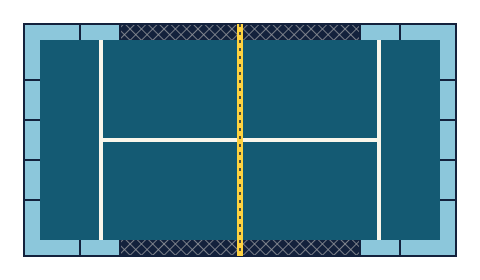
- Glass wall
- Metal mesh
- Net
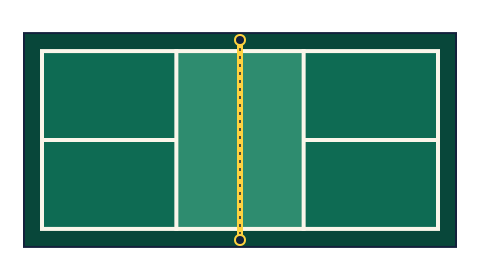
- Kitchen (non-volley zone)
- Net
Both are doubles-friendly, quick to learn and played with a paddle that has no strings. That's where the overlap ends. Padel is played inside a box of walls and metal mesh, and the walls are part of the game. Pickleball is played on an open court, and the game is decided at the kitchen line.
Here's how they really compare, based on the official rules: the International Padel Federation (FIP) Rules of Padel and the USA Pickleball Official Rulebook.
The short version
| Padel | Pickleball | |
|---|---|---|
| Court | 20 × 10 m (65.6 × 32.8 ft), fully enclosed | 20 × 44 ft, open |
| Walls | In play, after the ball bounces | None |
| Net height (center) | 0.88 m (34.6 in) | 34 in |
| Usual format | Doubles | Singles or doubles |
| Serve | Bounce it, hit at or below the waist | Volley serve (upward arc, below the waist) or drop serve |
| Scoring | Tennis-style: 15, 30, 40, game; sets to 6 | Usually games to 11, win by 2 |
| Equipment | Perforated pala (racket) with no strings + pressurized rubber ball | Smooth paddle + perforated ball (with holes) |
The court
Padel is played on a court of 20 by 10 meters, measured inside the walls. Service lines sit 6.95 m (22.8 ft) from the net. The ends are closed by walls 3 m high, topped with metal mesh up to 4 m in total, and the sides combine wall and mesh. The floor can be cement, synthetic material or artificial grass.1
Pickleball uses a 20 by 44 ft court for both singles and doubles. There's a non-volley zone, the "kitchen," that runs 7 ft from the net on each side. You can't volley while standing in it.2
What that means for you: pickleball lines are often painted onto existing tennis courts, so you'll find them in plenty of public parks. Padel needs a purpose-built enclosed court, so it usually lives at clubs.
The walls (padel's big idea)
In padel, once the ball bounces on the floor on your side, it can hit the walls or the mesh and stay in play. You can return it before it bounces a second time. You can even play it off your own wall to send it back over. What you can't do is hit the ball so it strikes the other team's wall or fence before it bounces on their floor. That's your point lost.1
The result is long rallies. A smash that would end a point on a tennis court can come back off the back wall.
The kitchen (pickleball's big idea)
Pickleball's twist is the two-bounce rule. The return of serve must bounce, and then the serving team's next shot must bounce too. After that, either team can volley. Combine that with the 7-foot no-volley zone and you get the soft "dink" game at the net that pickleball is known for.2
Serving
- Padel: stand behind the service line, bounce the ball in your own service box, and hit it at or below waist height with at least one foot on the ground. It has to land in the diagonal service box. You get a second serve if the first one fails.1
- Pickleball: serve diagonally. A volley serve must be hit with an upward arc, with the paddle head below your wrist and the ball below your waist. The rules also allow a drop serve, where you drop the ball and hit it after it bounces.2
Scoring
- Padel keeps tennis scoring: 15, 30, 40, game. Sets go to 6 games by a margin of 2, with a tie-break at 6–6, and matches are best of three sets. At 40–40, the FIP rules allow three methods: classic advantage, a single deciding golden point, or the new Star Point. With Star Point you play two advantages, then one deciding point. FIP is using Star Point on its pro and amateur circuits starting in 2026. At your local club, agree on which one you're using before you start.1,3
- Pickleball traditionally uses side-out scoring: only the serving side scores, and games usually go to 11, win by 2. In doubles the score is called as three numbers, and every game starts at "0–0–2." Rally scoring, where every rally wins a point, is provisionally approved as an option.2
Gear
- Padel: a perforated pala with no strings. Under FIP rules it can be up to 45.5 cm (17.9 in) long and 38 mm (1.5 in) thick, and it must have a wrist cord, which you wear. The ball is pressurized rubber, built to FIP specs for size, weight, internal pressure and bounce.1
- Pickleball: a paddle with a smooth surface. Length plus width can't exceed 24 in, and length can't exceed 17 in. There's no weight limit. The ball is perforated: larger holes are customary indoors, smaller holes outdoors.2
More detail in our beginner gear guide.
Which should you try first?
Honestly, try both. A quick way to decide:
- Want to show up and play today, maybe for free? Start with pickleball. Many Tampa Bay parks have public courts, and some rec centers lend paddles. Largo is one of them.
- Want a fast, social game with four players and a booked court? Book padel. Ask the club about racket rental. M Padel in Zephyrhills, for example, rents palas and supplies balls, with online booking and no membership required.
- Coming from tennis? Padel's scoring will feel familiar. Pickleball's kitchen will take some unlearning.
- Coming from racquetball or squash? You already know how to read a ball off a wall. That's half of padel.
Florida reality check
Outdoors, plan around the summer storms. If you hear thunder, you're likely within striking distance of the storm: get off the court and wait 30 minutes after the last thunder. Indoor and covered courts are your friends from June to September.4,5
Find courts: all Tampa Bay padel and pickleball courts · rules basics
Rules summarized from the official FIP Rules of Padel and the USA Pickleball Official Rulebook. Leagues, clubs and tournaments can use local formats, so always check with your venue.
Sources & attribution
- International Padel Federation (FIP), Rules of Padel, "Review of application 01.01.2026" · padelfip.com
- USA Pickleball, 2026 Official Rulebook · usapickleball.org
- FIP news, "introducing the 'Star Point'" · padelfip.com
- NWS lightning safety · weather.gov
- NWS Tampa Bay rainy season · weather.gov